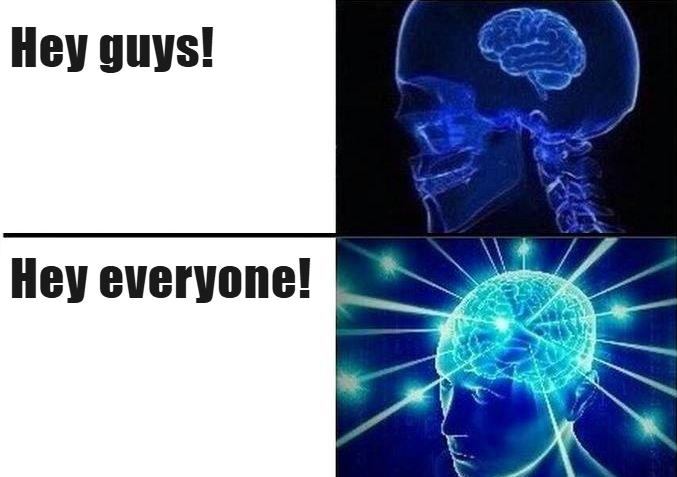
Language should include, not exclude
"Guys" gets tossed at whole rooms like it magically covers everyone in them. It doesn't.
Popularity isn't a permission slip. Just because many people use a term doesn't mean everyone's included by it.
"Guys" was never some neutral, universal default. It just got used like one long enough that people stopped questioning it.
A dictionary can tell you how a word gets used.
It cannot tell you how it feels to be erased by it.
"Everyone says it" is not an argument. It's a shrug dressed up as one.
Language has always evolved. Words considered perfectly fine decades ago are now recognized as outdated, harmful, or just plain embarrassing.
Those words changed because people spoke up, and enough other people actually listened.
So when someone says "I don't feel included," the correct response is not a debate about why they should.
You do not get to argue the feelings and lived experiences of others.
Old habits, no excuses
A lot of "default" language got built during eras when men were treated as the standard-issue human.
"Dear Sirs" stuck around because business, government, and every serious room got assumed male by default.
"Thank you, sir" still slips out automatically, because respect got tangled up with male titles a long time ago and nobody untangled it.
A default is not the same thing as inclusion. It's just a habit nobody bothered to question.
When someone says "I am not a sir," the reply should not be a lecture on how common the word is.
It's especially rich to dismiss someone's identity while still lining up for their expertise, guidance, or technical skills.
Respect doesn't get an opt-out clause the moment someone's knowledge becomes useful to you.
The actual response is recognizing that language can catch up to the world it claims to describe.
Women and everyone else who doesn't answer to "guys" or "sir" have always been in these spaces.
Nobody is trying to erase language.
The problem is language that assumes one group gets to be the default for everyone else.
Inclusive language isn't difficult. It's just accurate.
It reflects a world bigger than the assumptions baked into old habits.
Conversations we're tired of having
Person A: The term "guys" does not include me. I am not a "guy".
Person B: "Guys" is gender-neutral.
Person A: Some people don't feel included by that term. I do not feel included by that term.
Person B: Here's the definition: "You guys" is commonly used as gender-neutral, but some people find it exclusionary because of its masculine roots.
Person A: Exactly. That is the point. I find the term exclusionary. I am not a "guy".
Person B: I didn't understand the nuance. English isn't my first language.
Congratulations, you're now an etymologist
Someone explained that "guys" doesn't feel inclusive to them, and instead of listening, you reached for a dictionary to correct them on the meaning of the very word they were using to describe their own lived experience.
You appointed yourself the authority on a word while dismissing the person telling you how that word lands on them.
The dictionary isn't a trump card
A definition got presented like it could override someone's actual lived experience of feeling excluded.
A word can be common and still make people feel left out. Those two facts are not in conflict.
Saying "guys" is neutral doesn't make it neutral for everyone. If someone tells you a term doesn't include them, the smart move is to listen, not to explain to someone else why their feelings and their own lived experience is wrong.
It's a special kind of contradiction to dismiss someone's lived experience with language while still expecting that same person to hand over their technical knowledge, guidance, or help the moment you need it.
Respect shouldn't become optional the second someone's identity is inconvenient, while their skills stay very much in demand.
Watch the excuse change mid-sentence
After trying to explain the language to someone else, the argument shifted the moment things got uncomfortable for them.
Not understanding something doesn't excuse dismissing someone's lived experience of it.
The conversation moved from dismissing someone's lived experience to backtracking and claiming lack of understanding language nuances the second it got pushed back on.
Ask a straight cis man how many guys he's dated. Watch "guys" suddenly become a gendered term.
Fluent enough to lecture you on the word.
Suddenly "not a first-language speaker" the second they get called on it.
Patience is not a one-way street
English being someone's first language was never actually the issue.
The issue was the double standard: claim authority over the language, dismiss someone else's lived experience, then retreat to "I didn't understand" the moment it gets uncomfortable for you.
You don't get to demand patience and understanding for yourself while refusing to offer either to anyone else.
For those still catching up
Women and other non-"guys" ARE ON THE INTERNET.
We have been here all along.
We build.
We code.
We create.
We mentor.
We lead.
We BELONG anywhere we want to be.
The fact that some people are still surprised by our presence is not our problem to solve.
The internet has never belonged to one group of people.
Language should reflect that reality.
Language evolves. Time for you to evolve with it.